


 Česky (CZK)
 Deutsch (EUR)
 Slovensky (EUR)


PLA - Color - RAL N/A (LEGO blue)
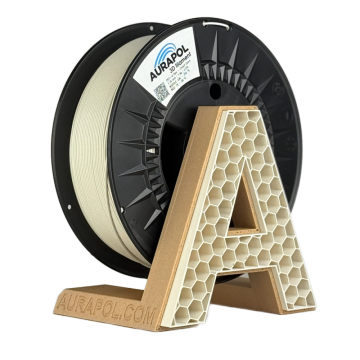
PLA is the easiest material to start with in 3D printing. It prints at a lower temperature, almost does not warp, and can be handled by a regular home printer. It is suitable for models, decorations, figurines, and prototypes. However, it does not belong in a car or in direct sunlight, it softens at around 58 °C.


AURAPOL PLA 3D Filament L-EGO Blue 1 kg 1,75 mm
Articles
Is PLA compatible with my 3D printer?
The 1.75 mm filament is compatible with Prusa, Bambu Lab, Creality, Elegoo, Anycubic, QIDI and most other 3D printers. The 1 kg spool also fits in the AMS. For printers using 2.85 mm filament, we offer PLA in black and white.
What is the difference between PLA and PLA HT110?
PLA HT110 maintains its shape at temperatures up to 110 °C, making it more heat-resistant than standard PLA. However, it is a design material rather than an engineering material, and the printed part will not withstand continuous exposure to 110 °C.
What temperature should I set for PLA?
Set the nozzle temperature to 210 to 230 °C, or to 230 to 250 °C for higher speeds or a larger nozzle. Set the heated bed temperature to 40 to 60 °C. In PrusaSlicer, select the Prusament PLA profile; in Bambu Studio and OrcaSlicer, choose Generic PLA.
Will a PLA print withstand being left in a car?
No. PLA can withstand temperatures of around 60 °C, but above that it starts to deform. In summer, temperatures inside a car can reach 80 °C. For automotive parts, use ASA or ABS (both require an enclosed printer), or alternatively PET-G.
Is PLA suitable for beginners?
Yes. PLA is the easiest material for 3D printing and is odorless. If you are new to 3D printing, start with PLA: set the heated bed to 40 to 60 °C and use 3DLAC for better adhesion.
Recyklace
doplnit text,
úvod:
o co se jedná
Everything you need to know about PLA filament
PLA (polylactic acid) is the most widely used filament for FDM 3D printers. It prints at a lower temperature than PET-G or ASA, experiences virtually no shrinkage while cooling, and prints retain their dimensional accuracy. That makes it great for beginners, while experienced printers also rely on it for models, prototypes, and decorative prints.
What PLA is suitable for and what it is not
It is ideal for models, figurines, decorations, prototypes, educational aids, and anything that does not need to withstand heat or mechanical impact. PLA prints soften around 58 °C and are rigid but brittle. Therefore, choose PLA HT110 for automotive or heating-adjacent parts, PET-G for stressed and flexible parts, and ASA for outdoor applications.
How to print AURAPOL PLA (basic settings for 0.4 mm nozzle)
- for a more matte finish, set a lower temperature
- for a glossier finish, set a higher temperature
What you get with AURAPOL PLA
- Filament manufactured in the Czech Republic with a diameter of 1.75 mm and a tolerance of ±0.02 mm. Black and white are also produced in 2.85 mm diameter.
- 1 kg spools (200 mm diameter, 67.5 mm width) that fit Bambu Lab AMS units, as well as large 2.5 kg spools (300 mm diameter) and 5 kg spools (350 mm diameter).
- Each spool is vacuum-sealed to prevent moisture absorption.
- Over 90 colors: solid, silk (glossy), metallic, marble, glitter, and translucent. Wood-look filaments have their own category, PLA Wood.
- Technical data sheet and food contact certificate available for download at the top of the page.
How to store PLA
Advisor
Tipy k tisku PLA HT110
Návod pro 3D tisk s materiálem PLA HT110
